Tuesday, December 1, 2009

Maroon Views from Deep Blue State Country

I just read an excerpt from a Ronald Reagan speech from the 1960s in which he cautions people about health care reform. It reads, in part:

“Now back in 1927 an American socialist, Norman Thomas, six times candidate for president on the Socialist Party ticket, said the American people would never vote for socialism. But he said under the name of liberalism the American people will adopt every fragment of the socialist program.
...
One of the traditional methods of imposing statism or socialism on a people has been by way of medicine. It’s very easy to disguise a medical program as a humanitarian project. Most people are a little reluctant to oppose anything that suggests medical care for people who possibly can't afford it.
...
James Madison in 1788, speaking to the Virginia Convention said: “Since the general civilization of mankind, I believe there are more instances of the abridgment of the freedom of the people by gradual and silent encroachment of those in power, than by violent and sudden usurpations.”
...
In this country of ours, took place the greatest revolution that has ever taken place in world’s history. The only true revolution. Every other revolution simply exchanged one set of rulers for another. But here for the first time in all the thousands of years of man’s relation to man, a little group of the men, the founding fathers for the first time – established the idea that you and I had within ourselves the God given right and ability to determine our own destiny."
This speech has been used by folks on the right in the current healthcare debate to reject the current efforts at reform. The idea that "They're trying to do it to us again! Reagan warned us!" makes red staters cry with self-righteous rage. "They're trying to make us socialists! Fight them at every turn!"

Here's my gloss on the subject, from Cambridge, Massachusetts, deep in Blue State Country: Reagan was absolutely right. And it's far too late.

The conundrum here is that a substantial number of Americans are frightened to death of the idea of their own 'freedom.' To them, if freedom means risk - to their standard of living, to their idea of justice, to the stability of their daily lives - they'd rather choose something else. Reagan's arguments resonate with those who aren't afraid, who are willing and eager to take on the responsibility and risk that comes along with the freedom he talks about. They sound scary as hell to everyone else.

Of course there's no shortage of demagogues who make a living out of encouraging that fear, and those folks get paid to find ways to reduce risk for their constituents. They've been telling people all their lives that "the risks of freedom are too high. We'll make them go away." And now almost everyone has come to benefit from those effects: their benefit checks, their tenure-based 3% standard of living increase, their government contracts, their prescription drug benefits, their mortgage deductions and their low interest rates so they can buy shiny things with borrowed money.

And here's the part that the red-staters don't want to talk about: the Republican party is just as guilty as the Democrats. Over the years, Republicans have been tempted by the same instinct that most Americans have for desiring a lower level of risk. Corporations have used them to protect profits and shield them from competition, seniors have convinced them to pass prescription drug benefits, and value voters have encouraged them to use laws to prohibit social practices like abortion. The mortgage deduction and unemployment insurance and the byzantine tax code, rigged to encourage certain practices over others, is all about using the government to reduce risk and guarantee comfort. Republicans, as well as Democrats, are told by their constituents to find ways to make business cycles go away, so the Federal Reserve is designed to 'smooth them out'. When the financial system melted down, the general consensus across the political spectrum was that the government should "do something" to reduce the dislocation that would result. All this encourages stability over freedom.

Human nature is such, folks. We're selfish creatures by default - both materially and emotionally. We like to be worry-free. Wanting material comfort is in our genes, and using what power we have to get ahead is a natural extension of that. Here in Massachusetts, I heard voters time and again say that they voted for the lionized Ted Kennedy for forty years because he brought back government largesse to the state. "He was good for Massachusetts," was the refrain. Around here, joining a union that fights to protect jobs at all costs, regardless of the consequences of the institution at stake, is a no-brainer. If you can pick up a low-intensity government job, or a police detail, or a disability pension, you're seen as lucky. You've "outsmahted the system."

Once we have something, we'll fight even harder to keep it. Preserving our own at the expense of the greater good is usually an easy decision. When the senate debate on the health care bill came to the floor this week, the first amendment the Republicans offered was one to protect the health care coverage of seniors. The social security system is unreformable because of the political fallout that would result from simply the *discussion* of a benefit reduction. In the health care debate, politicians soothingly promise that you won't lose anything you already have that you like - even if that thing could be replaced by something better. It's hard for most people to imagine things changing for the better, but everyone can easily imagine things changing for the worse.

Since World War II, America's unprecedented level of prosperity has made all this largesse possible. We could afford the handouts and the giveaways and the tax breaks and the bailouts because we had a powerful economic engine. People (both here and in the rest of the world) simply believed that we could grow our way out of our debts, and kept lending us the money we wanted.

The ugly truth that keeps this next part from being a cautionary fable is that we can probably keep doing that for a while. Maybe a long while. Past predictions about the free-rider carrying capacity of the American economy, and its eventual overload, have so far been overstated. For the rest of the world, America is still a far more transparent and stable and prosperous investment option than pretty much anywhere else on the planet. The risk-reduction sentiment is not confined to our country, of course. Every other country has significant constituencies lobbying for less risk and higher comfort every day, and large numbers of them have made their peace with this dynamic a long time ago: stability trumps freedom. Period.

Historically, too, the great scientific and political and economic upheavals of the 19th century made people yearn for a reduction of risk and a guarantee of material comfort. Communism, socialism, the union movement, "a chicken in every pot," national socialism, the Great Society, global warming - all are part of that trend. We've been doing this for centuries - pushing our governments to reduce risk and guarantee comfort as far as our systems will allow. When things get pushed too far things collapse, but we keep trying.

There is a great quote floating around that is relevant in this context:
"A democracy is always temporary in nature; it simply cannot exist as a permanent form of government. A democracy will continue to exist up until the time that voters discover that they can vote themselves generous gifts from the public treasury. [Emphasis added] From that moment on, the majority always votes for the candidates who promise the most benefits from the public treasury, with the result that every democracy will finally collapse over loose fiscal policy..."

I originally thought this was written by a Greek philosopher, but turns out that it's a 1950s-era paraphrase of an 18th century Scottish philosopher's comment about Greek democracy. Great. But while this compromises its historical pedigree, it doesn't make it less true.

Americans have historically settled for a different balance of the freedom-stability dynamic - one that tolerates some negative outcomes as a tradeoff for greater aggregate prosperity. And this fact explains our continued ability to both vote ourselves funds from the treasury and remain economically afloat. The people who are not afraid of risk, who don't dream of ways of living a prosperous life on the government's largesse - those people are the ones who continue to drive our aggregate prosperity forward, and upon whom the rest of the system depends. Very Ayn Rand of me, I know, but there it is. There has been a strain of American culture that celebrates those who take risks and succeed - from J.D. Rockefeller to Bill Gates to the guy who started a successful car dealership on credit card debt. Most Americans don't begrudge the rich their gains - in fact want to emulate them - as long as those gains were honestly earned. This cultural dimension inspires new generations of risk-takers to keep coming, and as long as they do we'll keep trying to push our system to take care of everyone else.

The bottom line is that human nature and generations of leadership have created a society of people incapable of living in a free society. If one were imposed today by fiat, many would starve while they waited for someone to help them. Think Hurricane Katrina.

So when Reagan asks frightened Americans to reject incremental socialism, it's like suddenly asking a child who has been told there's a bogeyman under the bed his whole life to "grow up and act like an adult". He doesn't even know what that means. And the uncomfortable, Rand-ian truth is that our society is doing well enough that it can afford to carry a certain number of these folks without breaking down. How many? No one really knows.

It's too late, folks. Socialism is here - deeply embedded in the minds of the majority. It's comforting and it's safe and it has nothing to do with freedom.

Friday, November 6, 2009

Three ideas for social media in Real Life

I've probably spent more time on Facebook and LinkedIn in the past eight weeks than in the past eight years (yes I know, some of that time those services didn't exist, but the symmetry of that comparison is rhetorically satisfying). I am now very committed to several strains of conventional wisdom on the subject, many of which seem, at first blush, to be contradictory:

1. Social media is going to change the way we interact. The ability to be instantly in touch with individuals *or groups*, in small and vital ways, is revolutionary.

2. Most social media is relevant only to the source, and of little interest to most others. My Facebook news feed is chock full of information from contacts I don't remember very well, about parts of their lives that have little overlap with mine. And yet - a Ryan Turner post introduced me to the funkadelic Har Mar Superstar, which was a very cool half hour diversion. An oblique reference to my Dad's passing in June resulted in a hundred condolence posts from old old friends, and made a huge difference to me during a trying time. I got far more out of my business school reunion by speaking to the people I hadn't friended on FB, because I wasn't reading daily excerpts from their lives every other day.

3. No one has time to absorb even a fraction of the good stuff out there. This is true. I have several Boing Boing bookmarks I keep meaning to go back to, a feed reader I somehow never view, and yet I already spend far too much time engaged in FB and such.

4. Social media is still a puzzle for businesses. The jury is out on whether businesses will be able to manipulate social media like they have other media. So far (aside from Adwords-style ads in the margins of pages), FB lets me choose when to engage in commercial activities, and I rarely do so unless there's a personal hook from someone I respect pointing me there ... and even then I usually avoid it. So far the commercial idea that has resonated with me the strongest when it comes to social media for business comes fromHubspot: put lots of stuff that's actually valuable out there for free, and people will follow it back to see what you're about. This approach has several things going for it: it's honest, karmically positive, and in-line with how social media is supposed to work.

But these observations are less damning than they appear, and similar things were said about the first wave of the web. It was clear back in the mid-nineties that the web would change the way we interact, but no one knew then how it would do so, precisely. Same deal here. At the time the web was frustratingly full of garbage and the real gems were hard to find. Google solved that problem decisively, and you don't hear that complaint very much at all anymore. Back when I was a web consultant in 1996, I had a twofold sales job on my prospects: I first had to convince them that a website was worth having at all, then I had to convince them to use me. The first part of that sales job has pretty convincingly vanished from the landscape.

So we will muddle through, and social media will seem as obvious and revolutionary as the net does, in a few years. And yet it's a different animal - imagining that the social media trajectory will look like the early web's is folly. There are things social media (and universal personal devices tied to the people who carry them) can do that seemed like science fiction just a few months ago. Here are three ideas to help move things along to the next phase:

1. BUILD ME SOME FILTERS, DAMMIT! There are gems of value out there in the social media streams - help me find them. WhenI hit my desk at work, filter out the social updates; reverse that trend when I'm checking from home before bed. Let feeds from people I like/work with/find relevant/click on a lot bubble up over the rest. If my Google search logs show that I'm thinking about online education, emphasize the streams from people whose blogging/tweeting keywords related to the ones I was using. I like reading executive summaries - prepare me one of the streams I care about, broken up topically or by relevance. I need a smart Google to help me make sense of these feeds.

2. Hook me to my neighborhood's/town's/region's streams. I just got an email forwarded to me about a string of break-ins happening in my town. It was written by the police and described the suspected folks pulling these jobs so we could be on the lookout. I was openmouthed when I finished - if everyone in my town got that feed, someone would doubtless be looking at the guys in real time, and call in a tip. Using social media to fight crime? How about that library committee meeting that happened last week that I never heard about. It was posted on the town's website (my town does damned well on that score, compared to others), but how often do I think to go to the town website? Do I care about all the notices? Lord, no. But my filters should know I'm helping with our local library and should have pulled that notice out of the sea for me to look at.

3. Give me a way to geo-locate strangers' streams, if they're willing. I'm writing this from the Minneapolis airport while I wait for a flight. I guarantee there are businesspeople around me who are in related businesses or who I might want to talk to. Sure, if I'm feeling private I want to be anonymous - but I could think of lots of situations where I would be open to the people around me. Conventions, for example - these are intended to provide a way for people to meet each other. Link that with some augmented reality stuff, and let me look through my iPhone to find the people I want to speak with in this room with big Sims-style pointers over their heads. Singles bars, parties - let me read the blogs of the people around me before I choose to introduce myself, and I'll find someone who seems interesting to zero in on. Bonus: their last tweet gives me a conversation starter too.

The good news is, people who have been thinking about this for far longer and in more sophisticated ways than me are doubtless doing all this as I type, and probably have funky funky names for them already in place. But I don't know about them yet. Find us, social media entrepreneurs of the world - we're waiting.


Tuesday, November 3, 2009

Bits becoming atoms, 2009 edition


I just finished watching Bronwen Blaney print an on-demand book.

A customer came in to the Harvard Bookstore in Cambridge, MA wanting an obscure 1860s-era work by a legal scholar he had found online, (scanned, conveniently, by Google). Bronwen selected the title from a database, previewed the PDF output on a screen with the customer watching, and sent it to the book machine, which was effectively a high-quality copy machine hooked up to an automatic bookbinder. The cover printed first - four color on a thick stock, and then she started 'heating up the glue.' The book downloaded in about three minutes, software converted the PDF to a printable format, and the sheets spit out into a receiver.

When complete, the stack of paper was painted by a roller coated with binding glue and folded into the cover in a special jig to keep it straight and let the glue dry. A few slices with some industrial-strength paper cutters later and the book chunked out into the output slot, looking indistinguishable from the paperbacks on the shelves behind us.

Yesterday, Bronwen said, they printed sixty copies on the machine. The only flaw we saw was that whoever scanned the original got their fingertips caught in the scanner on pages 79 and 347, so if anything, this copy has some character. Whoever they were they had a nice manicure.

Direct printing has been around for some time, but this kind of one-stop device at the consumer level is pretty new. The machine isn't home-grade yet, but honestly that's just a matter of time (as Google and Amazon have long figured out). Bronwen was pretty convinced that the short-term impact of these machines would be on back-list titles - out of print, copyright-expired ones, and eventually the titles owned by publishers who have determined that the demand is not enough for a full printing run. It's probably still cost-effective for front-list titles to be offset-printed centrally and distributed in boxes and palettes - although ask any bookseller about the environmental consequences of "no return" policies and they'll grimace. Wouldn't it be nice to keep a couple of centrally-printed copies on hand for display purposes, but if you suspect you'll sell fifteen copies tomorrow, why not print out that inventory locally the night before? No waste, and zero shipping or storage costs.

I started musing immediately about self-publishing. A simple model for a new business: give us the URL of your blog, we'll pull down the archives, source freelancers to lay out and convert your work to PDF, send you a proof, and then get Bronwen's machine to output a dozen copies for your friends or organization - or you can tell people to drop by Harvard Bookstore and get one printed out whenever they need one. Plus, we'll add your title to the online distributors so people can download it PDF style on their desktops or Kindles, and we'll set up a search-engine optimized marketing site and place a few keyword buys to drive the public to your title. Voila - disintermediation of the publishing industry - albeit on a low level - and every dollar not spent on paper and glue goes right to the author.

One thing is for sure - bits are separate from atoms, now more than ever. iTunes showed us the long tail for music; YouTube for video; now we have it for books. Real books, not just content. I would think that the economics would support these devices (smaller and slicker, perhaps, at a lower pricetag) in local bookstores within a few years. How a "YouTubed" book industry would look is an open question.

Want one at home? Any title ever written, whenever you want it, good enough to put on your bookshelf for future reference and intellectual bragging rights? Not a bad unique selling proposition. Bronwen, get on it.

Tuesday, October 27, 2009

Websites vs. Web presences

In a discussion with an old colleague yesterday, I realized that she and I would advise a client looking to build a web presence for the first time completely differently.

She would go down a brand-marketing path: spend time selecting a good company name, carefully-design your unique selling proposition, write elegant marketing copy and integrate it into thoughtful layout, prune-down and focus your copy, being sure to get it all correct before going live.

I would advise them to do the opposite: publish small chunks of super useful information, now and often, making sure that search engines and social media services found them, relegate a traditional website to the 'nice-to-have' category and don't worry about integrated content and design since most of the content will be separated from design anyway.

My logic went like this: people don't enter websites from the top anymore, they enter them from the side. If you don't *already know* the name and pedigree of the organization, you Google keywords about them, or stumble over a post on someone's Facebook page or a blog you follow. If you had to pick, a 'high velocity' brand in the social media-sphere will get you more bang for your buck than a beautiful, elegant website.

Her point was that no one has time to read blogs, and that one's blog consumption level is directly related to the amount of spare time one has. Search engine optimization is all well and good, but without a professionally-designed website, anyone clicking through will dismiss you as not being legitimate. In fact, the organization should be discouraged about having high lead-to-client expectations - websites are required baselines for doing business in this day and age, and it doesn't pay to mess with them.

After debating the two approaches for a while, we concluded that both are valid, of course - in fact, should be part of a unified approach - but that one might be emphasized over another depending on the organization. In other words, established companies looking to expand their well-known brand within reasonably defined markets should emphasize brand marketing and websites; young brands without much of a following should concentrate on getting the word out there by travelling the engines and social media pathways.

Thursday, October 22, 2009

The On-Demand CTO


In this day and age, not everyone can afford a full-time technology executive on staff. But just because one can't afford it doesn't mean one has to do without.

The On-Demand CTO gives you the right balance: someone who has taken the time to understand your business, is available when you need them, has no vested interest in pushing a product, and won't cost you an arm and a leg.

Here's how it works:
- Get to know your CTO ahead of time. Make sure the individual you're considering "fits" culturally with your organization, and exhibits a genuine interest in your challenges. Someone experienced in your direct industry is helpful, but most C-levels learn quickly, and sometimes an "outsider" perspective can be of use.
- Sign an engagement letter and NDA. This doesn't cost anything.
- Get your CTO acclimated. Let the CTO set up a series of conversations and site visits to meet with the individuals involved in your business - executives, managers, employees - to get up to speed. Depending on the size and complexity of your business, this can take days or weeks, and can be billed either hourly or on a flat-fee basis.

That's it. Now you have a trusted ally you can go to for technology issues. That can be a quick phone call, attendance during planning meetings, preparation of proposals, assistance with technology vendor selection - even project management or hiring oversight. Your CTO can be an experienced name on a business plan or a trusted voice for a Board presentation.

Traditionally you'll get billed by the hour, like an attorney. If you're engaging them for a specific plan or proposal or project, they may be willing to work on a flat fee basis. If you don't need the input, you don't use them.

Thursday, October 8, 2009

Raising Money from Angel Investors

I just returned from a 128 Innovation Capital Group meeting at a hotel on Route 128 in Boston. Turns out that I had attended one of their sessions more than ten years ago when raising money for my last startup WebOnTap, Inc. I know this because when I showed up at the venue my nametag had the WebOnTap name on it instead of my Augmented brand - a company name that hasn't existed since my partner and I sold the company to Endurance International (nee Bizland.com) back in 2000.

I used to attend a lot of these back in my earlier startup days, and I was struck by a few interesting things.
  • The average age of the attendees was at least 20 years older than I remember. Maybe it was my personal myopia at the time, but I could have sworn that the majority of folks in attendance in 1998 were people in their late 20s trying to start the next Ebay and hustling for money. That was at the height of the dotcom boom, of course, so I'm probably somewhat correct in my recollection. This event was much more mature (literally). For proof, during the "stand up and introduce yourself for 15 seconds" part of the meeting virtually no one exceeded their allotted time. Remarkable - I remember that little exercise taking *hours* back in the day.
  • Presenter Chris Sheehan (a managing member of CommonAngels, an angel funding group in Boston) laid out a process for approaching angels that had changed little since I last paid attention. The big difference was that Mr Sheehan acknowledged that initially getting in front of angels was almost always a function of working a personal network, and not of a compelling plan, per se. This was true last time I tuned in to the process, but Mr Sheehan acknowledged it up front this time.
  • I was also struck by the fact that there seemed to be many more angel groups out there than I recall, and that most seemed to have their act together. Last time I was involved in that world, angel groups almost didn't want to tell people that they were out there, let alone how to work with them (probably to filter out all the dreck that they were getting). I'm sure they get dreck now, but either less of it or they're better at screening after submission.
The entrepreneurs I spoke with were familiar, of course. Enthusiastic, starry eyed by the enormity of their ideas, and talking way too fast - probably because they were afraid I'd lose interest quickly.

For the record, I met Van Garrett of allmealdeals.com - a fascinating concept where small restaurants can offer short-term promotions on meals, which can then be distributed to you via Twitter or SMS (I'm now a subscriber). Tai Chan of Smargineering.com was pitching a novel mobile payments system, and Dave Belfer-Shevett was putting together the company around a homebrewed conference attendance application he's designed. It felt like old times.

But in one way it was markedly different: I'm not raising money. For me, this time, I didn't have that sense of tension and pressure that comes from having a payroll to meet or rent to pay or a pilot marketing campaign to get out the door. I may get back and do that again, possibly soon, but for now I got to sit back and watch without any real agenda - just interesting people and interesting ideas.


Thursday, October 1, 2009

Implementing What's Already Out There: The On-Demand CTO

Nothing New Under The Sun
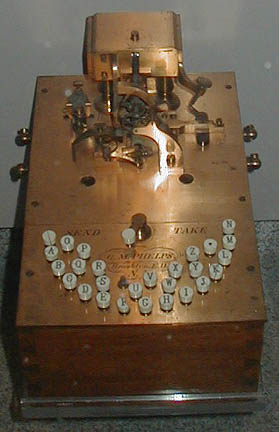
At London's Great Exhibition in 1851, the following inventions were on display: the fax machine, the dot-matrix printer, the digital copier, the disk drive, programmable computers, and e-mail. All these technologies were essentially the same in principle as their modern day equivalents, but used no electronics to function. It took more than a century for them to mature and become the devices we would recognize today.

Frederick Bakewell's fax machine (which he called the 'image telegraph') traced the dimensions of a picture with a needle, converting the image into a series of electrical on/off signals, which could be transmitted over a telegraph wire and reproduced remotely. After 1851, his technique was improved and commercialized, but never achieved wide acceptance, eclipsed by the expansion of simple telgraphy, the telephone, and later, radio.

Effectively, the Bakewell device was also a dot-matrix printer and digital copier, since it interpreted images on a simple binary grid and could output multiple copies after a single 'scan.' People familiar with the long streams of connected printer paper used to print posters for parties in the 1980s will no doubt recognize the output of Bakewell's device.


Barlow's Double Jacquard Loom used a series of cards stitched together into a long strand, each one punched through with holes. Pins on the device dropped into the holes, which controlled which arms of the loom and allowed patterns to be reproduced accurately. Whether a pin was in the up or down position was effectively binary information, and the storage on punchcards therefore used the same principle as modern disk storage technology.

Barlow's loom used principles similar to those of modern computing, in that instructions could be read from a storage device to control the disposition of a machine.


By 1851 electrical telegraphy was a well-understood field, capable of sending coded text transmissions over wires. At the Great Exhibition communications were displayed that had been received from over 200 miles distant, and the undersea cable from Britain to France was completed as the Exhibition ended. A telegraph message essentially converts simple text into coded electrical signals (Morse code being the most familiar to us) which can be transmitted, relayed, and stored for later reading. The fact that human beings and paper were used at certain points in the process was simply evidence that the technology hadn't matured yet. In principle, this was e-mail. In 1851.

In short, then, the principles of these incredibly practical technologies were already present more than 150 years ago. Many of them, like the telegraph, proceeded to be improved and enhanced in the years that followed, transitioning (from the perspective of history) seamlessly into today's technologies. Others languished or developed more slowly.

The Thankless Job Of 'Making It Work'
Once the principle was demonstrated, however, the creative mind could see quite clearly where these technologies were headed. This was solidly true in the Victorian era, where great breakthroughs in invention were made in almost every field in the early part of the 19th century, but took much longer to mature and gain widespread use and acceptance. Steam technology, materials, biology - the story is the same in almost every field. After the initial discoveries, the rest of the Victorian age was simply the story of people taking those breakthroughs to their logical conclusion. Individuals like Bakewell and Jacquard get credit for the invention of the machines, but generations of individuals followed them, making their original ideas work better, refining them for a specific use, or simply integrating them into the fabric of a business or organization.

We are living through a similar time today. Most of the major breakthroughs in technology took place several decades ago - computing, materials science, gene theory. Creative minds in the mid-sixties foresaw the Internet, composite ceramics, DNA databases, or at least saw the trends and extrapolated into visions recognizable today. The implementation of earlier ideas is, of course, often more difficult than originating the idea itself, because doing so must take a much broader set of conditions into effect: financial realities, markets, operational complexity, to name a few. The truth is that the challenge for the vast majority of today's businesses and organizations, especially when it comes to technology, is not coming up with new ideas but in implementing existing ones. One doesn't need to invent social networking, one just has to figure out how to use social networking to one's advantage.

But as simple as that sounds, that's a very difficult job. Not only must one invest the time and energy to understand the landscape of technology ideas already out there, scrutinize different solutions already in place by competitors and comparable organizations, and understand the wide range of financial and practical considerations inherent in any business or organization, but one must do that while somehow running your business day-to-day.

A tall order.

Whose Job Is Technology?
Now, one could spend the time and money to hire someone to do nothing but that - a Chief Technology Officer. Many organizations of sufficient magnitude do precisely that. But most others can't afford it, and make do with one of three situations:
  • senior managers try to do the work alongside their day-to-day responsibilities
  • managers rely on junior employees to research, suggest, and even implement solutions for the business
  • managers rely on salespeople from technology vendors to design solutions
Given the fast-moving developments and broad scope of the technology world and the increasingly time-intensive requirements of any manager's direct responsibilities, the manager-intensive solution is, at best, a hit-or-miss answer to the problem. Few have the time to do justice to it, even if their personal predilections make it intriguing or fun, rather than tedious.

While junior employees often have the time and enthusiasm to explore technological solutions to business needs, they seldom have the experience, breadth of vision, or access to information to be able to craft pragmatic solutions, let along embed them in longer-term strategies that can be implemented over time. Enthusiasm is not a solution for experience.

The worst possible solution is to put ones business in the hands of vendors with a vested interest in their own products. While these individuals often have the knowledge and resources to make the process seem effortless, one cannot deny that their motivations are not directly the success of your business or organization. They will claim it is, and with some justification, but in the end they don't work for you, and don't have the incentive to give unbiased opinions. Worse, many vendor representatives often repackage 'off the shelf' solutions and present them as customized plans, using their expertise to convince you that their solution applies to you. One size does not necessarily fit all.

The On-Demand CTO
What managers in today's small and medium-sized businesses need is someone they can turn to whose job it is to focus on the innovation-implementation problem. Ideally that individual has the following characteristics:
  • Has immersed themselves in modern technologies in a practical, hands-on way
  • Has broad business and operational experience, so they can tell the difference between pipedream ideas and ones that will make a real difference
  • Has no vested interest in one technology or set of products
  • Is available only when needed, for planning or evaluation or execution
  • Delivers both rapid verbal advice and detailed, concrete deliverables, depending on what's needed by the business
Finding the right person, who not only possesses these characteristics but with whom you can work as easily as you would with another senior manager, is part of the challenge. But it can be done, and the rewards are significant.

Michael Sattler is the Principal of Augmented Industries, Inc., a firm specializing in technology leadership for startups and established businesses. His three previous startup businesses and successful fifteen year track record as a senior technology executive give him a unique perspective on technology implementation challenges.