At London's Great Exhibition in 1851, the following inventions were on display: the fax machine, the dot-matrix printer, the digital copier, the disk drive, programmable computers, and e-mail. All these technologies were essentially the same in principle as their modern day equivalents, but used no electronics to function. It took more than a century for them to mature and become the devices we would recognize today.

Frederick Bakewell's fax machine (which he called the 'image telegraph') traced the dimensions of a picture with a needle, converting the image into a series of electrical on/off signals, which could be transmitted over a telegraph wire and reproduced remotely. After 1851, his technique was improved and commercialized, but never achieved wide acceptance, eclipsed by the expansion of simple telgraphy, the telephone, and later, radio.
Effectively, the Bakewell device was also a dot-matrix printer and digital copier, since it interpreted images on a simple binary grid and could output multiple copies after a single 'scan.' People familiar with the long streams of connected printer paper used to print posters for parties in the 1980s will no doubt recognize the output of Bakewell's device.

Barlow's Double Jacquard Loom used a series of cards stitched together into a long strand, each one punched through with holes. Pins on the device dropped into the holes, which controlled which arms of the loom and allowed patterns to be reproduced accurately. Whether a pin was in the up or down position was effectively binary information, and the storage on punchcards therefore used the same principle as modern disk storage technology.
Barlow's loom used principles similar to those of modern computing, in that instructions could be read from a storage device to control the disposition of a machine.
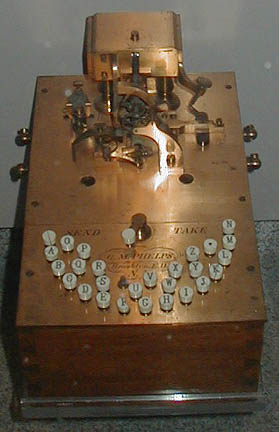
By 1851 electrical telegraphy was a well-understood field, capable of sending coded text transmissions over wires. At the Great Exhibition communications were displayed that had been received from over 200 miles distant, and the undersea cable from Britain to France was completed as the Exhibition ended. A telegraph message essentially converts simple text into coded electrical signals (Morse code being the most familiar to us) which can be transmitted, relayed, and stored for later reading. The fact that human beings and paper were used at certain points in the process was simply evidence that the technology hadn't matured yet. In principle, this was e-mail. In 1851.
In short, then, the principles of these incredibly practical technologies were already present more than 150 years ago. Many of them, like the telegraph, proceeded to be improved and enhanced in the years that followed, transitioning (from the perspective of history) seamlessly into today's technologies. Others languished or developed more slowly.
The Thankless Job Of 'Making It Work'
Once the principle was demonstrated, however, the creative mind could see quite clearly where these technologies were headed. This was solidly true in the Victorian era, where great breakthroughs in invention were made in almost every field in the early part of the 19th century, but took much longer to mature and gain widespread use and acceptance. Steam technology, materials, biology - the story is the same in almost every field. After the initial discoveries, the rest of the Victorian age was simply the story of people taking those breakthroughs to their logical conclusion. Individuals like Bakewell and Jacquard get credit for the invention of the machines, but generations of individuals followed them, making their original ideas work better, refining them for a specific use, or simply integrating them into the fabric of a business or organization.
We are living through a similar time today. Most of the major breakthroughs in technology took place several decades ago - computing, materials science, gene theory. Creative minds in the mid-sixties foresaw the Internet, composite ceramics, DNA databases, or at least saw the trends and extrapolated into visions recognizable today. The implementation of earlier ideas is, of course, often more difficult than originating the idea itself, because doing so must take a much broader set of conditions into effect: financial realities, markets, operational complexity, to name a few. The truth is that the challenge for the vast majority of today's businesses and organizations, especially when it comes to technology, is not coming up with new ideas but in implementing existing ones. One doesn't need to invent social networking, one just has to figure out how to use social networking to one's advantage.
But as simple as that sounds, that's a very difficult job. Not only must one invest the time and energy to understand the landscape of technology ideas already out there, scrutinize different solutions already in place by competitors and comparable organizations, and understand the wide range of financial and practical considerations inherent in any business or organization, but one must do that while somehow running your business day-to-day.
A tall order.
Whose Job Is Technology?
Now, one could spend the time and money to hire someone to do nothing but that - a Chief Technology Officer. Many organizations of sufficient magnitude do precisely that. But most others can't afford it, and make do with one of three situations:
- senior managers try to do the work alongside their day-to-day responsibilities
- managers rely on junior employees to research, suggest, and even implement solutions for the business
- managers rely on salespeople from technology vendors to design solutions
Given the fast-moving developments and broad scope of the technology world and the increasingly time-intensive requirements of any manager's direct responsibilities, the manager-intensive solution is, at best, a hit-or-miss answer to the problem. Few have the time to do justice to it, even if their personal predilections make it intriguing or fun, rather than tedious.
While junior employees often have the time and enthusiasm to explore technological solutions to business needs, they seldom have the experience, breadth of vision, or access to information to be able to craft pragmatic solutions, let along embed them in longer-term strategies that can be implemented over time. Enthusiasm is not a solution for experience.
The worst possible solution is to put ones business in the hands of vendors with a vested interest in their own products. While these individuals often have the knowledge and resources to make the process seem effortless, one cannot deny that their motivations are not directly the success of your business or organization. They will claim it is, and with some justification, but in the end they don't work for you, and don't have the incentive to give unbiased opinions. Worse, many vendor representatives often repackage 'off the shelf' solutions and present them as customized plans, using their expertise to convince you that their solution applies to you. One size does not necessarily fit all.
The On-Demand CTO
What managers in today's small and medium-sized businesses need is someone they can turn to whose job it is to focus on the innovation-implementation problem. Ideally that individual has the following characteristics:
- Has immersed themselves in modern technologies in a practical, hands-on way
- Has broad business and operational experience, so they can tell the difference between pipedream ideas and ones that will make a real difference
- Has no vested interest in one technology or set of products
- Is available only when needed, for planning or evaluation or execution
- Delivers both rapid verbal advice and detailed, concrete deliverables, depending on what's needed by the business
Finding the right person, who not only possesses these characteristics but with whom you can work as easily as you would with another senior manager, is part of the challenge. But it can be done, and the rewards are significant.
Michael Sattler is the Principal of Augmented Industries, Inc., a firm specializing in technology leadership for startups and established businesses. His three previous startup businesses and successful fifteen year track record as a senior technology executive give him a unique perspective on technology implementation challenges.


